Why does Narula offer “Source and Supply” for nonwoven types it doesn’t manufacture?
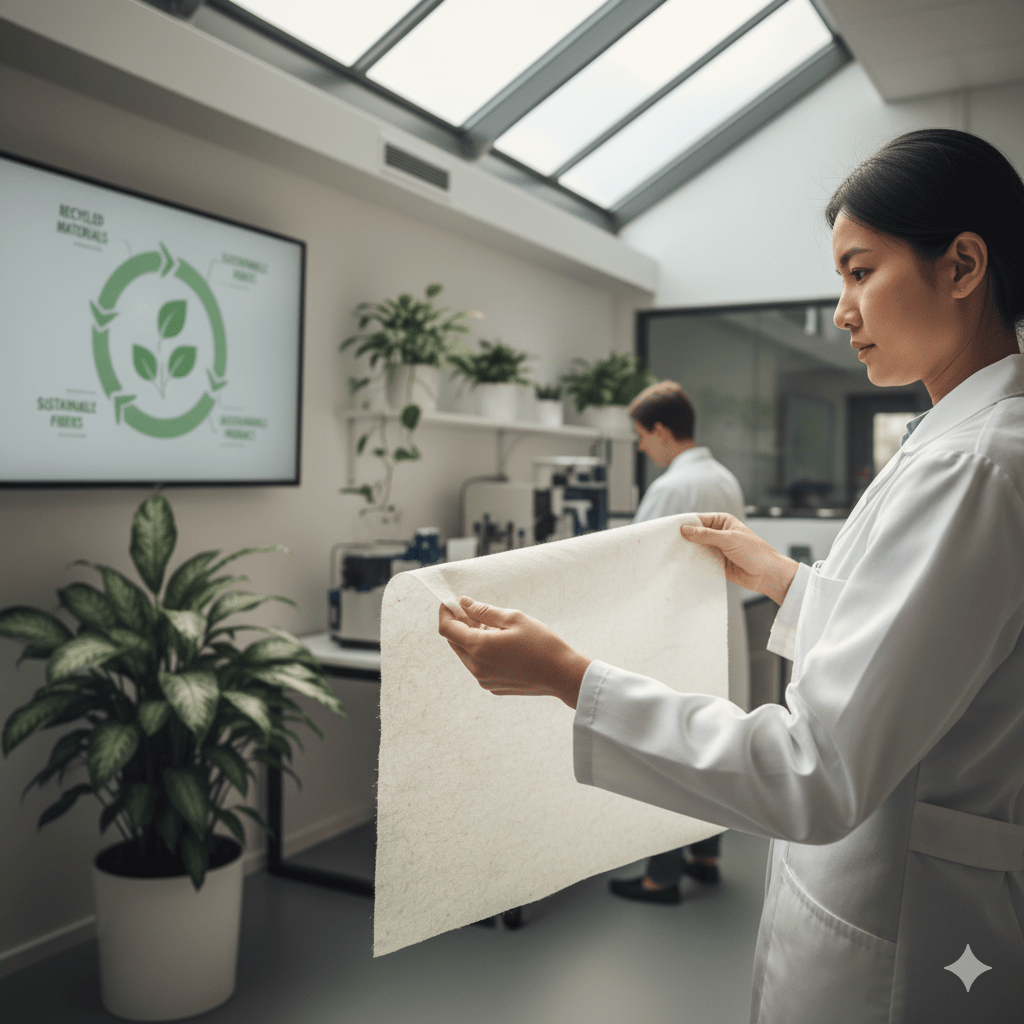
Narula Nonwoven is committed to being a complete solutions provider, recognizing that complex customer products often require specialized nonwoven types that complement the core PP melt-spun materials manufactured in-house. For example, melt-spun PP is highly durable and excellent for barriers but inherently lacks the high liquid absorbency or extreme softness required for premium hygiene products.
By leveraging its extensive industry network to source and supply these complementary materials—such as those based on natural fibers or alternative bonding methods—Narula functions as a one-stop-shop. This approach allows a customer to efficiently procure all necessary components for a complex structure (e.g., a strong PP backsheet, an absorbent Airlaid core, and a soft Spunlace topsheet) from a single, reliable partner.
What is Spunlace (Hydroentangled) nonwoven fabric, and where is it primarily used?
Spunlace, or hydroentangled, nonwoven fabric utilizes high-pressure fine water jets to mechanically entangle staple fibers. This chemical-free bonding method creates a soft, drapable fabric that closely resembles traditional woven textiles.
Spunlace is prized for its exceptional softness, high tensile strength (though generally lower than spunbond), and superior liquid absorbency. These characteristics make it the dominant choice for applications requiring gentle skin contact and high liquid uptake. Applications include disposable wet and dry wipes (baby care, industrial, cosmetic), surgical dressings, and medical towels. Spunlace fabrics typically incorporate blends of synthetic fibers like polyester (PET) and natural, absorbent fibers such as viscose or cotton.
What are Needle-Punched nonwovens and their unique role in durable applications?
Needle punching is a mechanical bonding technique classified as a dry-laid process. It involves repeatedly forcing barbed needles through a fluffy fiber web, physically interlocking the staple fibers to reinforce the structure. This process is highly advantageous because it does not require added chemical binders or heat to bond the material.
Needle-punched nonwovens produce thick, dense, felt-like materials known for exceptional durability, structural integrity, and thermal insulation. Crucially, needle punching offers tremendous raw material flexibility; it can process virtually any type of staple fiber, including natural fibers (like wool or jute), synthetics (like polypropylene), and recycled fibers, resulting in a product that is 100% fiber content. Key durable applications include heavy-duty geotextiles used for foundation stabilization, erosion prevention, and road underlayment, as well as automotive interiors, industrial filters, and insulation.
How do Airlaid nonwovens differ, especially concerning absorbency?
Airlaid nonwovens employ a unique web formation process where short fibers, primarily wood pulp or fluff pulp, are separated (defibrated) and deposited into a uniform, high-loft web using air streams. The web is then consolidated using thermal bonding (if synthetic fibers are present), latex spray, or hydrogen bonding.
The structure of airlaid webs results in a lower density, greater softness, and an absence of the laminar structure seen in carded webs. Airlaid nonwovens are highly valued for their superior bulk and capacity for liquid absorption, often achieving an absorbency range of 8 to 20 ml/g, which generally surpasses spunlace fabrics. Due to their exceptional liquid holding capabilities, airlaid materials are essential for the super-absorbent core layers in advanced hygiene products such as disposable towels and adult incontinence pads.
What is Wetlaid nonwoven fabric and how is it used in specialty fields?
Wetlaid technology closely mirrors traditional paper manufacturing. Fibers are dispersed in water to create a slurry, deposited onto a moving screen, and then dried and finished. This process is particularly effective for handling very short or brittle fibers, including cellulose or even synthetic fibers.
Wetlaid nonwovens are known for achieving high web uniformity and are often used to create very thin, high-performance materials. Applications span several specialized fields, including filtration media for air and liquids (such as tea or coffee bags), medical applications, personal care products, and components for composite reinforcement.
4.6. What are the emerging trends in Nanofiber nonwovens (Electrospinning)?
Electrospinning is an advanced manufacturing technique used to produce nonwoven fibers at the nanoscale—typically orders of magnitude finer than conventional Meltblown microfibers.
Electrospun nanofiber webs provide revolutionary filtration performance due to their extremely high surface area and minuscule pore size. This unparalleled efficiency makes them critical for the next generation of filtration media, capable of enhanced capture properties for sub-micron particles. Additionally, this technology can be adapted to process specialized materials like ceramics or metals. Key high-end applications for electrospun nonwovens include high-efficiency air purification (HEPA) filters, advanced chemical defense clothing, specialized sensors, and highly precise biomedical applications such such as tissue engineering scaffolds and drug delivery systems.
The following table summarizes the global nonwoven manufacturing landscape, detailing the core products manufactured by Narula and those provided via its strategic source and supply network.
Global Nonwoven Technologies Overview
Technology | Narula Status | Bonding Method | Key Characteristic | Primary Fiber Type | Primary Applications |
Spunbond | Manufactured Core | Thermal, Mechanical | High Strength, Durability, Stiffness | PP, PET (Continuous Filaments) | Geotextiles, Packaging, Diaper Backsheets |
Meltblown | Manufactured Core | Thermal, Mechanical | Superior Barrier & Micro-Filtration | PP, PET (Ultrafine Fibers) | Face Masks (Filter Layer), Air/Liquid Filters |
SSMMS | Manufactured Core | Thermal, Mechanical | Strength + Multi-layer Barrier (Composite) | PP, PET (Filaments + Microfibers) | Surgical Gowns, Critical PPE |
Spunlace | Source & Supply | Hydroentanglement (Water Jets) | Exceptional Softness, High Absorbency, Drape | Viscose, PET, Cotton (Staple Fibers) | Wipes (Wet/Dry), Medical Dressings, Cosmetics |
Airlaid | Source & Supply | Thermal, Latex, Hydrogen | High Bulk, Superior Absorbency (Pulp) | Wood Pulp, Short Synthetic Fibers | Diaper Cores, High-Absorbency Towels, Wipes |
Needle-Punched | Source & Supply | Mechanical Entanglement (Needles) | Felt-like Texture, High Durability, Versatile Fibers | PP, PET, Natural Fibers (Staple) | Automotive Interiors, Geotextiles (High Loft), Insulation |
Electrospinning | Source & Supply | Electrostatic | Nanofiber Scale, Extreme Filtration Efficiency | Various Polymers | Advanced Filters, Biomedical Scaffolds |